
3.1 Invertebrates
What is an invertebrate?
There are a varied multitude of invertebrates that live in woodland habitats, in bushes and the tree canopy, in and under rotting wood, under rocks and in tree bark, in the soil and leaf litter, and in woodland ponds, ditches and streams. They are the primary architects of life on Earth! If it wasn’t for these small creatures pollinating plants and breaking down dead plant and animal matter into soil we wouldn’t have most other life on Earth.
Invertebrate hunting is often a young person’s first authentic experience of seeing wild animals up close. We have come across very few children that are not curious or excited by their discoveries, and for those who are scared or squeamish of the furry, slimy or skittish, often they too can turn their fear into fascination given the right facilitation.
The following are some brief profiles of common invertebrates that you are likely to find in the UK.
Wood ants
There are four different species of wood ant in Scotland. The Scottish wood ant and the hairy wood ant are both found in coniferous woodlands. The narrow-headed and red robber ant are both found on the edges of woods.
Identification of wood ants
Features common to all wood ant species, differentiating from other ant species:
- Black head and abdomen with a red thorax.
- Build a large, thatched mound as a nest in which to live.
- They are larger than other ant species in the UK, up to 10mm.
Differentiating between UK wood ant species (requires a hand lens):
- Narrow headed wood ant: deep notch at back of head, unique to this species.
- Scottish wood ant – Sparse, short hairs around top of head which do not reach the eyes; hair along top of thorax is sparse and short compared to hairy wood ant.
- Hairy wood ant: short hairs on top of head reaching the eyes; hairs forming continuous line along top of thorax to waist which are longer than those of southern red and Scottish; long hairs emerging from sides of thorax when viewed from above.
- Southern red wood ant; shows absence of hairs around top of head in between eyes; few short hairs long top of thorax.

Behaviour and interesting facts
All woods ants are territorial, and the narrow-headed wood ants have been known to defend their territory by climbing on the backs of other species of wood ants and decapitating them with their strong mandibles.
Wood ants are social creatures, and ants’ nests can be home to as many as 250,000 individuals. The colony is made up of a queen (which can live for 15 years or more), workers, (which are sterile wingless females), and males (who only live long enough to mate with the queen on nuptial flights after which they die). The whole colony acts as one organism with interchangeable roles.
Wood ants are solar engineers building their nests so that the south facing slope of the nest is at the shallowest angle with a large surface area facing the sun. They open and close entrances to the nest to regulate the temperature inside the nest, and also sunbathe on top of the nest on sunny days to absorb heat that they then release in the brood chamber.
As well insulating the wood ants’ nest, the pine needle ‘thatch’ is also showerproof, allowing rain to run off the surface rather than soaking into the nest.
They can spray formic acid, as a form of defence, a distance 12 times their own length.
The life expectancy of a female worker wood ant is only 60 days, the males live only a few weeks, but queens can live 15 years or more.
Pine resin has antibacterial properties so, by incorporating this into their nests wood ants are protected from bacteria and fungi that could otherwise harm them.
Queen ants get around nine hours of sleep a day. Worker ants only get around four hours of sleep a day.
The narrow-headed wood ant (Formica exsecta), Scottish wood ant (Formica aquilonia) and the hairy northern wood ant (Formica lugubris) are all near threatened species, as designated by the IUCN (International Union for Conservation of Nature). This is mainly due to loss of the native pinewood habitat on which they depend.
Some facts about ants in general
There are 50 species of ant in the UK, and there are some 900 species worldwide. There are more ants roaming the planet than any other creature. The combined weight of all the ants on Earth would total more than the combined weight of all the humans.
Ants are very strong for their size and can lift many times their own bodyweight (estimates vary). There is a Cornish belief that ants were fairies in the final stages of earthly existence, gradually, generation by generation, becoming smaller.
Ants are fascinating creatures and to do them justice would require far more than can be written here; follow some of the links in resources to find out more.
Games
Team ants (or passing the caterpillar)
Work as a colony and see how your team can move a giant caterpillar (a long balloon) from the base of a tree to your anthill 20 metres away, using only your heads.
Team ants (or formic acid fun!)
Half your group are ants running around trying to get aphid honey dew (yellow pompoms) from the trees without being eaten by the ant eating spider.
Games from www.woodants.org.uk
Shield Bugs
Members of the Pentatomoidea, a superfamily within the order Hemiptera or ‘true bugs’, defined by their sharp, straw-like mouthparts that are usually used for piercing plant tissue and sucking up sap, though some bugs prey on other invertebrates

Identification of shield bugs
- They are insects so have six legs and three body sections.
- Many species have an overall triangular shape, with a pointed end to their abdomen.
- Have a well-defined ‘scutellum’, the hardened extension of the thorax over the abdomen.
- Have mouthparts adapted into straw like structure.
Colouration and size vary with exact species:
- Common Green. Overall green, excluding where wing tips rest over tail end which is brown. 12 – 14mm length
- Hawthorn. Green triangle in centre of back, framed by red sides and pronotum (area behind head), tail end of abdomen also usually red. 13 -15 mm in length
- Woundwort. Greenish-grey, black and white fringes. ‘Shield’ and head can have metallic, coppery sheen. 5-8mm length
Behaviour and interesting facts
Most UK shield bugs feed on sap, though there are four carnivorous species. Many shield bug species favour one particular kind of plant and are often found on that species and are named after that plant, e.g. hawthorn shield bug, sloe bug (with hairy legs), gorse shield bug and birch shield bug.
When threatened shield bugs secrete a smelly liquid to repel enemies, and they are often known as stinkbugs. There are 46 species of shield bug recorded in the UK.
Spiders
There are approximately 40,000 species of spider around the world, only one of which is not a carnivore! In the UK we have 600 species of spider
Identification
A spider’s body consists of two parts, the front cephalothorax and the rear abdomen.
They have eight legs. Most species have eight eyes on the front of their head, though some have only four.
Their mouthparts have fangs with which they trap their prey and inject a fatal venom. This venom first paralyses the prey and then turns their insides into a liquid soup, which the spider then sucks up through their powerful mouths.
Spiders also have two appendages at the front of their body that are often mistaken for extra legs. These are in fact called palps and function like a pair of arms or hands helping the spider grab its prey. These palps are a great way to determine the sex of your spider. If the palps look like they have boxing gloves on the end of them, then your spider is male; if there are very small swellings, then your spider is female. These ‘boxing gloves’ are used by the male spider to show sexual interest in a potential mate. They are also used as ‘sexual pipettes’ to inject sperm into the female.

Behaviour and interesting facts:
Spider silk is five times stronger than steel of the same diameter.
The silk that is made by a spider (and by the caterpillars of butterflies and moths) is produced by a spinneret from the back end of the abdomen. The silk is initially liquid which then solidifies when exposed to air.
Games
Musical spiders
See if you can get a spider to come out to check if there is some prey on its web. You do this by banging a musical tuning fork and then placing it gently on the spiders web which imitates the vibration of a possible catch! Apparently the vibration of a tuning fork in the letters C, F and E work best! (thanks to Nick Baker for this game).
Myriapods – Centipedes & Millipedes
Both centipedes and millipedes are members of the myriapod phylum, meaning ‘many legged’. Within the UK there are 57 species of centipede, and around 50 millipede species.
Despite their names they do not have 100 or 1000 feet, the exact number varying with the species. In the UK centipedes range from 15-101 pairs of legs (always an odd number) and millipedes having between 20-200 pairs.
Identification
Differentiating centipedes and millipedes:
- Centipedes have one pair of legs per body segment, millipedes have two pairs.
- Centipedes’ bodies are often flattened, with the legs arranged out to the side, millipedes are usually cylindrical with the legs arranged beneath the body.
- Both are variable in size and colouration with species. Centipedes can range from browns to reds and yellows.
- Centipedes often have long antennae, compared to the shorter antennae of millipedes, and have elongated legs at rear similar in length to antennae, a feature lacking on millipedes.
- Head of centipedes is usually distinct from rest of body, whereas millipedes’ head is more integrated into body.
Identifying common species:
- Common Centipede: up to 3cm long; brownish-red body; 15 pairs of legs (this is a common feature of all Litobius genus, the stone centipedes).
- White-legged snake millipede: 50 pairs of legs; shiny black, long, cylindrical body; white legs which contrast against the dark body.
- Flat-backed Millipede: 20 pairs of legs; approx. 25mm long; orange-brown body; flattened body more resembling a centipede.
Behaviour and interesting facts
- Centipedes produce venom, like spiders do, to either defend themselves or to subdue prey as they are carnivores feeding on other centipedes and invertebrates.
- If a centipede loses a leg, it can grow a new one to replace it.
- Common centipedes can live for up to three years.
- Millipedes are detritivores, like worms, that feed on dead matter. This makes them important soil makers, using their strong mouthparts to eat dead leaves and other vegetation which, through their droppings, they turn into nutrient rich soil.
- Millipedes need to eat almost ten times their own body weight in food each day due to the low nutritional content of their food.
- Millipedes defend themselves from some but not all predators by creating chemicals that smell or taste nasty. Some also roll themselves up in a spiral to protect their softer underparts with their more robust uppermost exoskeleton.
- Millipedes have simple eyes capable of detecting light and dark only. They can live up to 11 years in captivity.


Earthworms
There are 26 different species of native earthworms in the UK. Aside from being a food source for many other larger animals, earthworms are a keystone species in most habitats, recycling dead and decomposing plant material back into fertile soil, though most of the earthworm’s nutrition comes from the fungi and associated decay, rather than dead plant matter itself
Identification
- UK earthworms species range in length from 1-30 cm (the longest UK specimen on record was 40cm!)
- Earthworms have a legless, long, thin body, divided into segments.
- Mature specimens have a wider, paler, slightly raised series of segments called a saddle or clitellum (only about half the worms you will find will be mature enough to have this feature).

Behaviour and interesting facts
Within an acre of native, unmanaged grassland there are an estimated three million earthworms processing dead plant material and creating burrows that aerate the soil to help water seep through. They also produce worm casts. All this creates fantastic nutrient-rich soil, which helps plants grow.
Most earthworms are 70-95% water. They have cells that are light sensitive on their body as well as bristles that respond to the slightest vibration which helps them navigate and interpret the world around them. The head of the worm (where the mouth is) is the smallest, thinnest end of its body. The bristles (setae) on the earthworm enable it to grip the wall of its burrow and fight off any predator that is trying to pull it out.
Earthworms are hermaphrodite (have male and female reproductive elements). However, they do need another worm to reproduce. Some can live for up to 10 years.
Bumblebees
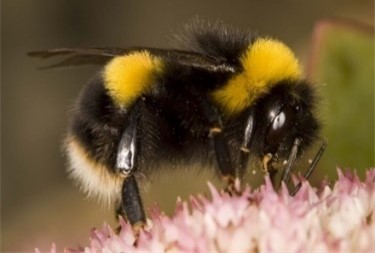
There are 24 different types of bumble-bee in the UK. They are social species, living within nests.
Bees, like wasps, butterflies, and moths, are responsible for the pollination of many of our plants. They do not make honey as they do not need to store food for the winter.
Identification
- Appearance will vary within a species by the caste it occupies within the nest.
- Bumblebees are overall hairier than honey or solitary bees, and average between 1.5 to 2.5cm long.
- Colour varies between species, commonly showing a degree of yellow and black banding within the body.
- Show one large pair of transparent flight wings, not contained within a hard ‘shell’.
- Antennae are not rigidly angled, unlike ants, and can be straightened.
- Tree Bumblebee (female): ginger thorax; white tail; occupy woodland, gardens and open countryside.
- Red-tailed Bumblebee (female); Overall jet black with a bright red or orange-red tail
- White-tailed Bumblebee: yellow collar, yellow abdominal band and white tail.
- Common Carder Bee: overall shades of brown, with no white tail, ranging from ginger to sandy brown.
Behaviour and interesting facts
- Often will nest in the ground, commonly in deserted bird or mouse nests.
- Of the 24 species in the UK most are social species, with each nest having: a queen, male drones, and female workers.
- Six of the 24 UK species are parasitic, taking over nests established by other species.
- After hibernation in the winter, the queens first eggs develop into four to eight worker bees, who take over the queen’s pollen collecting duties and caring for the nest.
- The ‘black and yellow’ colouration found in bees and wasps is an example of ‘aposematic colouration’, where the organism advertises that it is dangerous; many species have a hardwired response to these colours, recognising it as indicating danger. Species such as hoverflies mimic this colouration, despite being harmless, as they take advantage of the reputation of being black and yellow and avoid being predated.
Game
Dance the honey bee dance
Honey bees communicate the location of food sources by dancing the message to the rest of the colony. Can your group communicate where their lunch time snacks are hidden in a similar way?
Butterflies
The peacock butterfly is one of 59 species of UK butterflies, most of which are resident year-round, with three species regularly visiting and breeding in, the UK
Identification
- Overall colouration varies with species and differs on upper and lower surfaces of the wing.
- Two clubbed antennae (unlike moths that do not have the ‘clubs’ at the end of their antennae) for smelling, and balance.
- Four wings, a larger upper pair and smaller lower pair, covered in coloured scales.
- A long thin proboscis (mouth parts) for sipping nectar rolled up under the front of the head or uncurled when inserted into flower.
- Peacock Butterflies: overall red and black colouration; four ‘eye-spot; wing underside mottled brown; wingspan 63-69mm, upper end of UK species
- Small Tortoiseshell: red-orange wing, with black and yellow markings. Wings fringed by blue spots around edge of wings.
- Orange-tip: white wing upper surface; males with orange tips to forewings and light-grey wing tips; females with grey-black wing tips, lacking orange.
- Large white: White wings with black tips to forewings; females have two black spots and dash on each forewing.

Interesting facts
- Adult butterflies show a preference for which plants they lay their eggs on. Often these are the favoured food of the caterpillar: peacock butterflies laying on nettles; orange tip liking ladies smock flowers and garlic mustard; and whites preferring brassica species.
- Many butterflies can taste with their feet.
- Caterpillars are the larval stage of the butterfly species, as maggots are to flies.
- There has been a 55% decrease of UK butterfly populations between 1999 and 2015.
- Peacock butterflies will ‘hiss’ when threatened by rubbing their wings together.
- Along with bee species, butterflies are important invertebrate pollinator species.
Gastropods – Slugs and Snails
Slugs and snails are gastropods (meaning stomach-foot). They have an un-segmented soft body. Gastropods are part of the mollusc phylum that includes whelks and mussels, squids and octopuses. Here we are concerned with terrestrial (land based) species, primarily slugs and snails.
Identification
- Slugs and snails have an unsegmented soft body. Differentiated by the presence or absence of a hard external shell, which snails have, and slugs do not.
- Slugs and snails have two pairs of tentacles, one responding to light, the other to smell.
- The body, or ‘foot’ is mostly longitudinally ribbed in appearance, behind a smoother and tougher mantle at the front of the body, with a breathing hole, or pneumostome, on the right side of the mantle.
- European black slug: black, though immature individuals can be brown or ivory grey; 10-15cm in length.
- Leopard slug: overall grey-brown colour, with black spotting arranged along length of the body.
- Common garden snail: shell height 25-35mm; shell is thick with a rough, wrinkled surface and 4.5–5 whorls; shell usually pale brown, occasionally yellow; shell marked with up to 5 spiralling bands, variably flecked with white or yellow brown and having lateral yellow zig-zagging lines.
- Banded snails, Cepea spp.: shells bright coloured with brown, yellow or white stripes, common UK species differentiated by colouration of shell lip being either brown or white.
Interesting facts
- Black slugs can take up to a year to reach maturity. They are hermaphrodite, and though they prefer to find one or more mates, they can self-fertilise. They can lay up to 150 eggs at a time, in dark moist places such as under moss. Slugs generally live up to two years.
- Slugs evolved from snails, the shell being lost perhaps allowing the organism better mobility and access to tighter spaces, though this left the slug more susceptible to drying out.
- Slugs and snails help plants regenerate by moving plant matter around and thereby helping with seed dispersal.
- Slugs and snails have a toothed tongue, called a radula, which has up to 27,000 teeth! This serrated tongue is used to break down food into smaller pieces to be further broken down and digested by enzymes. As detritivores they recycle decaying matter into more usable fertile soil. They in turn also provide a food source for badgers, foxes, hedgehogs, slow worms, and various birds.

Beetles
This is the largest group of animals in the world! With over 370,000 different species worldwide, beetles make up a quarter of all animals on the planet and exist in every habitat other than the marine and polar regions! However in the UK we have only 4,100 species.
Identification
- As insects, beetles have six jointed legs, three body parts (head, thorax and abdomen) and a hard exoskeleton including hard elytra, (forewings that form a hard shell covering flight wings where present) which meet down the middle of their abdomen.
- Violet ground beetle. Up to 35mm long; overall black colouration with violet iridescence all over, especially around edge of elytra which is almond shaped; elytra are fused, and beetle is unable to fly; antennae are ‘beaded’, not consistent in diameter along their length.
- Woodland dor beetle. Between 12-20mm long; shiny black all over, with iridescent purple on underparts only; abdomen short and oval; antennae having three pronged ‘combs’ at tip; pointed keels on legs; elytra are dotted into longitudinal groves.
- Tiger beetles: These beetles come in a variety of different colours and belong to a large family called ground beetles. Tiger beetles are ferocious hunters, feeding on spiders, ants and caterpillars. They are also one of our fastest insects on the ground (though they can fly). There are 2,600 known tiger beetle species worldwide. The fastest known tiger beetle can run at 9km per hour (5.6mph). This is the equivalent of a human running 480 miles (770kmh) per hour!

Interesting Facts
Violet ground beetles
- They are nocturnal hunters of other insects as well as slugs and their eggs, and worms.
- Larvae are carnivorous and hunt the same invertebrates as adults.
- During the day these beetles hide under rocks or logs.
Woodland Dor beetles
- Also known as dung beetles, they are important recyclers of waste. They use this dung to feed their larvae in underground burrows.
- The are often called ‘lousy watchmen’ as they are commonly infested with copper-coloured mites. They are also known as ‘dumbledores’, from an old English word that describes an insect that flies with a loud buzzing or humming sound.
Tiger Beetles
- In 1998 an American entomologist (insect studier) discovered that tiger beetles in fact go temporarily blind when pursuing their prey. He noticed that these beetles would stop and start frequently when hunting which he found was due to the optical receptors not being able to keep up with the beetles speed and therefore the ‘stopping’ gave them time to be able to see again.
Woodlice
Sometimes known as pill bugs or slaters, there’s more to a woodlouse than meets the eye. Woodlice are tough little creatures that play a vital part of the ecosystem. They can be found almost everywhere and especially like dark, damp places. Be sure to look under loose stones, bricks or old logs and leaf litter.
Identification:
- Woodlice have a hard exoskeleton made up of several ‘plates’.
- They have seven identical pairs of legs, and belong to a group of animals called isopods, which means ‘identical legs’.
- They have antennae for feeling their way in the dark and a cluster of eyes used to detect darkness and light.
- At the back of the woodlouse there are what looks like a further four antennae (there are in fact only two of these but they fork and therefore look like they are four). These antennae are used for feeling their way around but they also act as the distributor of a nasty smell if the wee creature feels threatened.

Interesting facts
Isopods belong in a larger group called crustaceans, which include lobsters, prawns, and crabs. Woodlice are the only crustaceans that are adapted to life on land (other crustaceans always live in or near water).
Woodlice have gills at the rear undersides of their bodies in the form of tiny white patches, which always need to be kept damp .
There are records from as late as the 1930s stating how a grandfather treated his grandchild for jaundice by grinding up woodlice in a mill and feeding it to him! (Bugs Britannica p82)
Some say their Scottish name ‘slaters’ come from the fact that these creatures are often found hiding under roof slates or from their overlapping plated exoskeleton.
The female woodlice has a brood pouch between her front legs where she keeps her eggs; miniature adult woodlice hatch from the eggs and the mother continues to look after them until they are large enough to survive on their own and leave the protection of their mother.